Hello kind folk of Eummena and beyond,
If you follow us on social media, you have noticed that we attend quite a few events. True. And from those events, we usually put together a short overview of the things we did and liked during the event.
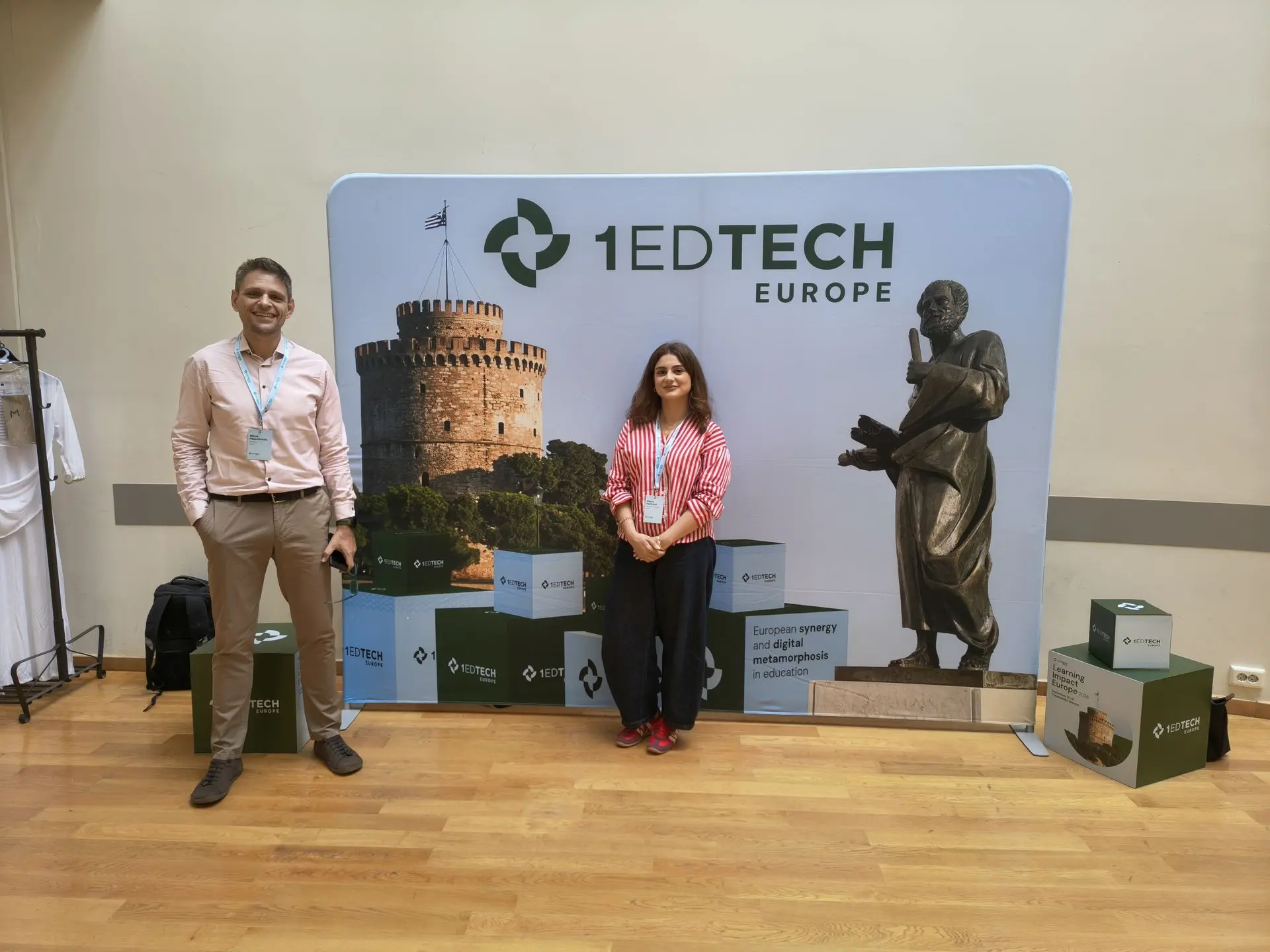
Well, Learning Impact Europe 2026 was no different! This was the first event since 1EdTech Europe became a legal entity in Europe, so it was quite an important one. What is “1EdTech Europe” I hear you ask. Well, let me give a brief background on this.
1EdTech Europe is the governing body for 1EdTech members based in Europe. 1EdTech is actively building an integrated foundation of open standards that makes educational technology work better for everyone. Now, 1EdTech Europe has arrived, to fit global standards to European needs by aligning with European models and frameworks and incorporating European regulation into our verification and certification.
Simple right?
Learning Impact Europe
So, as proud members of 1EdTech, we travelled to Thessaloniki which was a stone’s throw away for many of us, or a couple of throws for others. Eummena participated in the event with a four-person team and a paper submission on the amazing work that our colleague Ms. Shana Hazboun is carrying out, in the context of her PhD.
More on that, later

The event was hosted on the grounds of the Aristotle University of Thessaloniki and more specifically in the Aristotle University Research Dissemination Center. We kicked off Tuesday morning with a couple of very interesting workshops. With four of our members there, we attended almost every session, but this blog post will be reflecting on the ones I attended personally or the ones that my colleagues told me about.
15/9 | 10:00-11:00
So, my first session was titled “European by design: global interoperability delivered”, in which Mr. Xavi Aracil talked to us about the Edu-API and briefly touched on Open Badges. In this session we had the opportunity to use an online tool to work with Edu-API and look into how Edu-API is mapped to the European Learning Model (ELM).
15/9 | 11:30-12:00
Next stop was “Shortening the distance to Interoperability” with Mr. Jeff Merriman, Mr. Fransesc Santanach-Delisau and Mr. Joshua McGhee. In this session we had the opportunity to listen to the case of the Open University of Catalonia, and get to know how they use Edu-API and Campus API both within the university and as part of the OpenEU Alliance.
15/9 | 12:00-13:00
For my next session, I stayed in the same room to see “Understanding and Explaining Interoperability” from Mr. Quelic Berga-Carreras and Ms. Evelien Renders. This was a very inspiring and insightful session, where they showcased how interoperability is not only a tech problem, but it also has roots in culture. As the session finished, I have to admit that the illustration created by Bea Crespo “De como internet fue tomado por la tristeza” for El Pais, was something that stayed with me. After the theoretical part of the session, we had the opportunity to work hands-on with material from Interopvisual to see how components in the digital education landscape connect.
15/9 | 14:30-15:30
After a much needed lunch break, I joined “Trusted Learning Context for AI in education”, led by Mr. Tim Couper. The session gave us a deep understanding of how AI is used in education, and personally for me, it shed light on many things that I had not thought about before. First and foremost, the economics of agentic AI. How many tokens are consumed for each agentic task compared to a single chat exchange (spoiler: by a factor of around 1,000). Overall, the presentation addressed the question of how education can embrace AI and still stay in control of the data, the governance and the associated costs, which is a really critical question going forward. My takeaway from this presentation was the need for learning context that can drive how we use AI and what kind of information AI provides to the learner.
15/9 | 16:20-17:15
After a warm welcome from our hosts, we followed the Keynote presentation from Mr. Panagiotis Kampylis, “Building Future-Ready Learners, Workers and Educational Communities”. Mr. Kampylis looked into how AI is emerging as an additional layer in education and how it shapes the dynamics and relationships of the dyad between a teacher and a learner (which now becomes a triad essentially). He pointed out the need for reflection while using AI and also discussed the SELFIE Tool and the self-reflections collected through it. Last but not least, he discussed the need for deliberate decisions for interoperability as well as the use of AI.
...and that's a wrap!
Our first day ended with a welcome reception in the patio of the Aristotle University Research Dissemination Center, followed by a visit to Thessaloniki’s castle. There, apart from the breathtaking views, we also had the chance to witness a marriage proposal take place - not from event participants, which we made sure did not go unnoticed, by cheering for the happy couple!
Learning Impact Europe (day 1)